
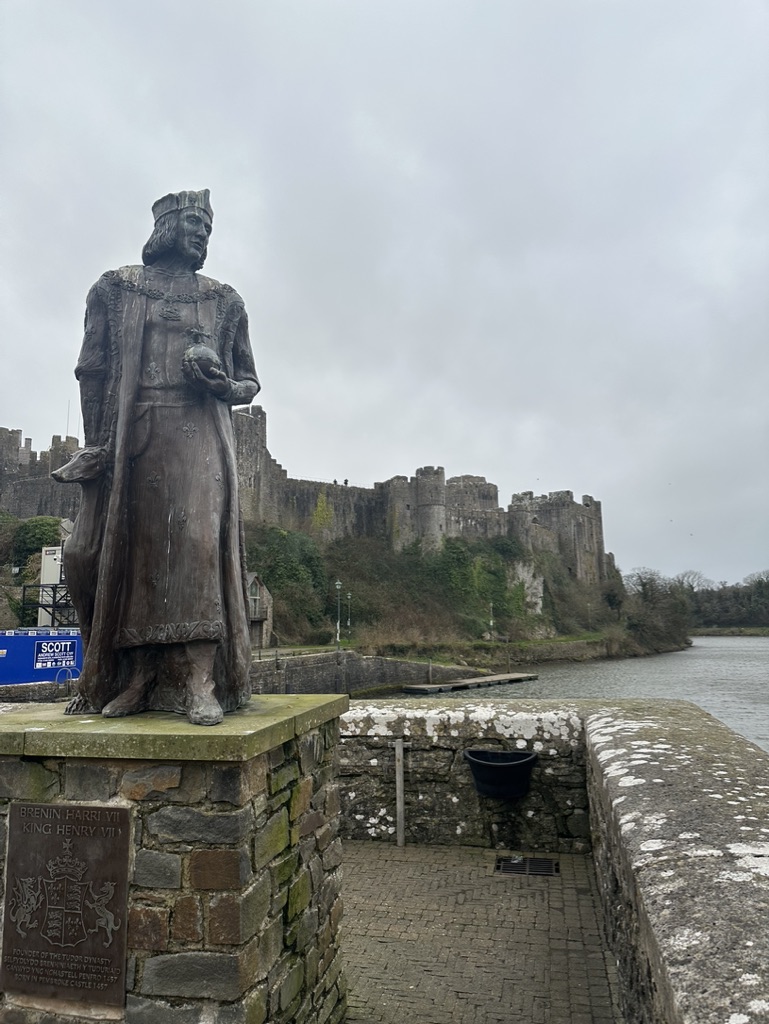
Discover Richard III and Henry VII’s Castles in Pembrokeshire, Wales
Located about five miles apart (and just up the coast from Tenby in Wales) lie Pembroke Castle and Carew Castle. Once home to waring factions, there is still clearly some rivalry between the two castles. Carew Castle was home to Richard III and Pembroke was the birthplace of King Henry VII (to the very stern Margaret Beaufort).
Table of contents
We visited both castles in a day which I’d recommend, not only due to their proximity but as there are a number of stories which involve both. This means that seeing the castles together really helps to bring it all to life. Plus it really isn’t too much to see in one day and you won’t get information fatigue.
One of the things I was most surprised by was the role which West Wales played in shaping medieval and early modern Britain. This was highly naive on my part, especially due to the link between coastal towns and trade at the time. This is probably because Henry VII didn’t return to Wales after becoming King. Also the title of the Marchioness of Pembroke was bestowed on Anne Boleyn, and let’s face it, she hasn’t exactly been covered in glory by the history books.
Pembroke Castle
Let’s start with the OG: Pembroke Castle. Towering over the River Cleddau, it isn’t just steeped in history; it shaped it. Pembroke Castle like all good British landmarks has a strong link to the Tudor dynasty – it was the birthplace of Henry VII, the first Tudor king. And don’t they like to remind you.

We opted for the guided tour, which I’d highly recommend, despite how cold and wet it was. It is safe to say December 30th isn’t peak time to tour Castles on the Welsh coast! The tour lasted 90 minutes, it was included in the ticket price and the guide was so enthusiastic. It really brought Pembroke’s pivotal role in Welsh, British and Irish history to life.
One thing that struck me was how Pembroke doesn’t shy away from confronting the grittier sides of history. You’re reminded, for instance, of just how grim life could be for women in the medieval period. Noblewomen were often betrothed as children and expected to bear heirs by the age of fourteen (which if you think they often only lived to forty isn’t as bad as it sounds to the modern ear, but still…). And yet, the historians here have gone the extra mile to uncover more about these women beyond their roles as “wombs on legs” (respect). You come away feeling that their stories, though often overlooked, are finally being told.
Pembroke Castle also had its share of innovations. Did you know its iconic round keep was the first of its kind in Britain and Ireland? Before that, castle towers were almost always square. This pioneering design was a milestone in medieval castle-building, and you can’t help but feel a sense of awe as you stand beneath it.

Pembroke Castle is good value for money. You can easily spend more than three hours there as there are so many nooks and crannies to look around.
Fun facts I learned at Pembroke Castle
- In medieval Wales, candles were a luxury, so people dipped reeds in animal fat for light (practical but… grim).
- Pembroke means ‘lands end’ in Welsh. This reflects the position of the castle and town at the tip of the Welsh coast.
A few logistics
There obviously was not the need for a Car Park when Pembroke Castle was built. This means parking is a bit of a walk. It is down a small hill, which means it is accessible but if you struggle to walk, consider being dropped at the entrance.
Pembroke Castle is about a 15 minutes walk from Pembroke Train Station. This is not the most well-served station (about one train an hour on the Swansea line) but it is doable if you plan. More information on accessing Pembroke by train is available via the Trainline.*
Pembroke Castle costs £11 for adults and you can buy tickets at the gate or in advance here.
Carew Castle
After Pembroke, we headed to Carew Castle, which has a very different vibe. If Pembroke is all about grandeur and power, Carew feels a bit more… romantic and mysterious. Nestled by the tidal Carew Millpond, it’s smaller but packed with character. There’s also something undeniably atmospheric about its semi-ruined state, with ivy creeping up the stone walls and echoes of its past whispering through the bare rooms.

One of Carew’s claims to fame is its connection to Sir Rhys ap Thomas. He was a Welsh nobleman who was instrumental in Henry VII’s victory at the Battle of Bosworth. It’s said he entertained the young Henry at Carew before the famous battle that would end the Wars of the Roses. You can’t help but imagine the plotting and tension that must have filled these halls at that time.
It’s probably no suppose therefore that Carew Castle claims it was at its most splendid during the reign of Queen Elizabeth I. The castle was granted to Sir John Perrot in 1558, who was claimed to be an illegitimate son of Henry VIII (there were a lot of these claims, but it would have meant he was a half-brother to Elizabeth and probably some would have thought a similar legitimacy to the throne. So good to keep him happy). Perrot like many was sent to the Tower of London and died there.

Carew was a battleground and it was very much in demand during the English Civil War. It was passed between Parliament and the Royalists four times.
More of Carew Castle is outside (or feels like it) than Pembroke. This meant we spent less time at Carew. See my point about December 30th not being a prime time to visit exposed Welsh Castles).

Carew Castle’s other unique feature is its proximity to the only restored tidal mill in Wales. The walk to the Millpond is about 20 minutes from the castle. It is a good path for kids to run along and is a great place for a picnic (if there isn’t a storm).
A note on logistics
Unlike Pembroke, Carew Castle is not really accessible by public transport. There is a car park which is a flat walk to the castle.
Carew Castle costs £7 for adults and you pay at the gate.
Only time for one? Choose Pembroke.
If I could only visit one of the two castles, I would go for Pembroke. It is bigger, has a guided tour but more fundamentally, it felt better thought out for visitors all year round. More of the rooms at Pembroke Castle had exhibitions or were dressed. This meant the history of the castle was brought to life in a more compelling way. Plus the cafe was really really good, and there was not one at Carew Castle.
Save Pembroke and Carew Castles for later







Leave a Reply