Especially if you don’t give a shit about Game of Thrones
After visiting Dublin in February, we decided to explore Belfast, the Irish capital north of the border. This post will talk you through what we did, what we enjoyed and some history of the city. If you’re looking for Game of Thrones, leave now! No, I’ve still never watched it.
Before arriving, I had a fairly muddled set of expectations and not much of a plan. What I found was a compact, walkable city with a complicated history and a strong sense of identity. Belfast wears its past openly, sometimes uncomfortably, but it is also creative, friendly and easy to explore over a weekend
All prices in this post are correct as of January 2026.
Contents
Reflections on my trip to Belfast
I usually write a bit of history about where I visit but there is no way I could do Belfast justice. Equally I could over-simplify an issue and make a significant error.
What I will say is this. Belfast is a city that feels raw with emotion. There is division clearly bubbling not far between the surface.
The impact of “the Troubles” can be seen and felt throughout Belfast. In every park, on every street corner. You are left in no doubt that every road in the city has a wound. It could be that someone died, went to prison, or was injured on the site you are standing on.
Barbed wire still frames many buildings and entrances in Belfast. There are also still city gates that divide the Protestant and Catholic areas at sunset. You are constantly reminded that Belfast is a city that was recently at war with itself.
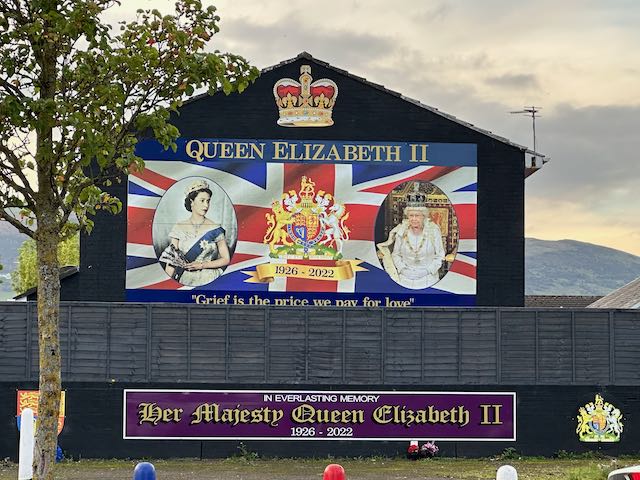
Belfast is also more proudly British than most of mainland UK (if anything it reminded me of Gibraltar). There were flags everywhere and more public tributes to the late Queen Elizabeth II than I have seen on the mainland.
Key things to know about a trip to Belfast
As Belfast is in the UK, if you are a British citizen, you don’t need a passport to fly there. British citizens need a photo driving license. Belfast uses British Pounds as its currency and British Plugs.
If you are coming to Belfast without a UK passport, you should check here to see if you need to have an ETA.
How long should I spend in Belfast?
We spent three nights in Belfast which allowed enough time to see the main highlights and to leave the city and visit the Giants Causeway.* However, I could have easily spent another night and seen a little more.
Belfast Itinerary for a Long Weekend
Day one: travel, a famous ship and some history
We took a stupidly early flight to Belfast (7.30 – good thing we live near the airport).* With three nights booked, we had four full days to explore the city, making it the perfect Belfast city break.
We arrived at Belfast City Airport, a tiny airport with just ten gates but very convenient for a city break. The number 600 bus took us to the city centre in ten minutes for just £2, ideal for first-time visitors to Belfast.
After dropping our luggage, we walked across town to the waterfront. Here we popped into the SSE Arena to see the venue, and took in the unusual stained glass installations along Belfast’s waterfront.
Trip details:
Length: three nights.
Travelled by: BA flight to to George Best City Airport*
Stayed at Hampton by Hilton.*
Travelled around Belfast: by foot.
This should have been our first clue: Game of Thrones.* Now I am one of those people who will proudly tell you she has never watched this. It was clear very quickly that we would not understand a good amount of what other people visited Belfast for.
Stop One: Belfast’s Titanic Museum
The Titanic Museum is the centre-piece of the Titanic Quarter. This section of Belfast has recently been regenerated. It now hosts a suite of entertainment, businesses, tourist attractions and a little housing. The museum is an imposing building. It is located in the centre of the dockyard. The site is surrounded by a range of memorials and ways of visualising the loss of life on the Titanic.
Your museum ticket* gives you entry to two things: the SS Nomadic. This is the only ship by White Star Line still in existence. You of course also get entry to the Titanic Museum itself.

The striking thing about the Titanic Museum is how little of it is actually about the tragedy. The museum is incredibly well-planned. It cleverly tells the story of Belfast’s booming textile, rope, and shipbuilding industries. It looks at the culture in late nineteenth and early twentieth century Belfast. This includes how people lived and worked at the docks or related industries. The museums is also VERY keen to point out that the sinking of the Titanic had nothing to do with the structural integrity, building or engineering that went into the ship. At the museum you will learn about the issues with the ship. You will quickly understand that none of them are linked to it being built in Belfast.
The Titanic Museum also goes big on the 1998 blockbuster movie.* Especially that neckace. It is well worth a visit even if you weren’t a fan of the film.
One of my highlights from the museum was actually the shop. The merchandise ranged from tacky (replica of the necklace that the old lady dropped in the ocean anyone…) to the damn-right distasteful (Titanic bath toy, anyone?!).
We also stopped for lunch at the Titanic Museum. I was skeptical about the ‘authentic’ nature of the halloumi fries. However, the Chicken Lasagne was very good (also not sure about how authentic to the Titanic this was, but it was tasty!).
After this we walked to go and see the SS Theresa (complete with some cracking canons). She was sadly closed for repair.
Tickets to the Titanic Museum are best booked in advance. Entry to the museum is timed. You can visit the SS Nomadic either before or after. Advance tickets are £24.95 for adults, walk-up tickets are £26.95. It is not cheap, but we spent about four hours at it.*
Stop two: Belfast City Hall
We walked (about 30 mins) from the harbour back to the town centre and the City Hall. It is a stunning baroque building, with well-manicured lawns and memorial statues.

As a member of the public not seeking to register a birth, marriage or death, you can book a (free) tour of the building or visit the exhibition (also free). The exhibition was fascinating. It was difficult not to constantly compare how the same events were told Dublin. It was definitely interesting to see two sides of the same story in one year.
Stop Three: Some shopping
Belfast has a great shopping centre. It has all the chain stores you would expect in a major city in the UK and some which are now closed on the mainland. There is also an obligatory Celtic and Rangers store, depending which Scottish football team takes your fancy. No shop however can quite compete with Carrolls Irish Gift Shop.
Carrolls in Belfast surprised me. It was the same shop as we found in Dublin and it had much of the same Irish merchandise. Not Northern Irish merchandise or culture, but Irish. I’d been indignant when we went to Epcot the year before because they nodded to Ireland as a United entity and as one home nation. Now I think I might need to get down from my high-horse. Well, a little.
Day two: Belfast’s Murals, Troubles, Crime, Flowers.
Stop one: self-guided murals tour

The murals and street art in Belfast are exemplary. The only place that comes close is Berlin and the art from the wall. There are two main ways in which you can see the murals. The first way is through a taxi tour*. These are usually hosted by someone who was involved in ‘the Troubles’ (please note I have not done the linked tour). You can also wander the street and do a self-guided tour. In the interests of time (and getting in our steps) we decided to have a self-guided visit. We used our trusty Lonely Planet guide*, combined with a bit of Google.

Of the things that stuck with me the most was how present the divide still is. This gate is still locked each evening and divides the Catholic and Protestant areas of the city. The second was the outpouring of support for both the Israeli and Palestinian communities. There are a number of murals showing solidarity with Palestine. The current war in Gaza has led an outpouring of support. The streets in the Catholic areas were draped in Palestine flags and the houses in the Protestant area were covered in Israel flags. The best explanation of these loyalties I have found is this piece from 2017 in the Economist.
Stop Two: Crumlin Road Gaol
A walk around the murals can conveniently end at the Crumlin Road Gaol. This is well worth a visit. The gaol has been meticulously restored. The museum talks you through the Irish legal system, what people were in the prison for throughout different twentieth century. It is well thought through, so the story of the gaol flows. The range of videos and holograms help bring to life how the inmates lived. The narrative talks you through different protests at the gaol. These were conducted by political prisoners and demonstrates how the death penalty was given as a punishment too. One of the highlights of the gaol is the cartoon explainer of the troubles. It was one of the clearest pieces I saw the whole time. This might say more about me than anything else.
Crumlin Road Gaol is £14.00 for adults if bought in advance or £14.50 if bought on the door. A visit to the Gaol lasts about 90 minutes.
Stop Three: Belfast’s Botanical Gardens
About 45 minutes walk from the gaol is the botanical gardens. The gardens are free to walk around (this is probably reflective of the fact they aren’t the best ever). Our highlight was seeing someone and their groupie filming a rap video in one of the glasshouses and by the rose garden (where everything was half dead).
Stop Four: Ulster Museum
The Ulster Museum is conveniently located in the Botanical Gardens and is also free to enter. It has an eclectic range of exhibits, worthy of the British Museum.
Perhaps we had been spoilt by the Gaol in the morning, but the video about ‘the Troubles’ in the Ulster Museum is terrible. It was weird and revolves around a slightly creepy dynamic between an older man and a twenty-something girl sitting in the museum. Seriously, if you aren’t there when it begins, don’t wait 10 minutes for the video like I did.

The jewel in the Ulster Museum is (as with many British museums) not a local artifact, but an Egyptian Mummy. It’s bloody incredible that you can see the preserved body and really brings home what mummification does! Disappointingly, the taxidermy was quite tasteful and well done.
Stop five: Books, Paper, Scissors
Opposite the botanical gardens you will find a lovely independent bookshop called ‘Books, Paper, Scissors’. It does not stock hundreds of books, but ones which it recommends you read. Most books in the shop were by Irish or American authors and many were pretty left-wing. They also had beautiful stationery. Worth the stop for a browse.
Stop six: Queen’s University Belfast
By this point we were TIRED, so did not give Queen’s the time it really deserved. However, the main building and campus are stunning and worth a quick look. The main building reminded me of a British boarding school and you could feel a busy atmosphere on campus.
Day three: Out of Belfast to explore the Giants Causeway

Our tour: Paddywagon from Belfast
We opted for an organised tour which included Dunluce Castle, some trees from Game of Thrones (pretty but meh), the Causeway and lunch at the driver’s mates pub. The tour was organised by Paddywagon (oh yes…), which can be booked through GetYourGuide.com.* It was brilliant.
A couple of notes – the guide was hilarious. He was obsessed with the house prices in each village. I did find that the low-level matchoism grated a little. He also has some great stories. Apparently, the people who own Liam Neeson’s childhood home have a sign at the front telling visitors he doesn’t live there.
The Giants Causeway is really a site like no other. The downside is like all beautiful sites these days. Other people on a quest to get the perfectly posed Instagram photo. This means you don’t get to see every corner of the causeway unless you are willing to join the queue.

If you have National Trust membership the visitor centre is free. I didn’t think the visitor centre would be worth paying the £15 non-member fee for.
Day Four: market, a photo and home
Stop one: commercial square
I had seen lots of photos on Instagram of Commercial Square. This meant of course I was absolutely determined to find something to eat or drink in Commercial Square. There wasn’t really anything if you weren’t up for a pub, which at 10 am I was not. Even when in Ireland.
Stop two: St George’s Market
St George’s Market is a bit of a gem. It is only open Friday, Saturday and Sunday and includes a bit of everything. If you’re a local, you can go and get fish, clothes dryers. The market has cool souviners including prints of Belfast (we got a fab pop-art image of the iconic crane). If you’re looking for gifts you can choose from leather bags and Irish lace.
We also stopped for a great pumpkin-spiced latte at Drop Hopper. Better than Starbucks is my review.
Things we didn’t have time to do in Belfast
If we had longer, we would have added two more things to our visit: the Irish FA museum and talk (about 1.5 miles outside of Belfast) and a visit to Stormont to see the Northern Irish Assembly.
What to read about Belfast
One of the best books I’ve read about this period is “Say Nothing” by Patrick Radden Keefe (it’s also now a TV show on Disney+), and it’s really worth your time.*
*This post contains affiliate links, if you use one to make a purchase, I will get a small commission at no cost to you.
Save ‘what to do in Belfast’ for later





Leave a Reply